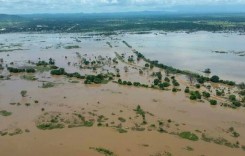
With the worst of the storm having passed, huge areas of north eastern India are now facing the heavy rainfall and flooding brought by the aftermath of Cyclone Phailin.
As many as 100,000 people are completely cut off from the outside world in Mayurbhanj and Balasore districts of Odisha. Four people have been reported as killed in the floods in Odisha.
Several rivers in Odisha, including Baitarani, Budha Balanga and Subernarekha have dangerously high levels and have burst their bansk. The flood waters of Baitarani river have affected Korei, Jajpur and Dasrathpur blocks in Jajpur district, although some reports say that the river levels are starting to recede.
Flooding from the Budha Balanga (Budhabalang) has inundated villages in Remuna, Balasore sadar, Jaleswar and Bhograi blocks. The district headquarter town of Mayurbhanj, Betanati and Badasahi blocks were also severely flooded.
Odisha Revenue and Disaster Management Minister SN Patro said:
“Army, Navy, Air Force and NDRF have been deployed in the flood-hit areas of the state. We are starting to air drop food packets in Balasore district. The flood situation there is a cause of concern”
Video Report on floods in Odisha:
Bihar Floods
There is now concern across India for the situation in Bihar, a state particularly vulnerable to flooding. Heavy rainfall as a result of Cylone Phailin is expected to last several days there.
According to The Hindu:
The next 48 hours are believed to be crucial as heavy rains in neighbouring Nepal could cause flooding in the northern parts of the State.
So far the worst affected area has been Purnia district, and much of the heavy rainfall has been in the low-lying areas of the state. On average, Bihar has seen around 8cm of rainfall in the last 24 hours. There have been no deaths reported in Bihar as a result of the storm or floods. Currently water levels of the Gandak and Kosi rivers are not at danger levels. More likely to pose a more immediate threat of flooding is the Adhwara group of rivers, which originate in the foot hills of Nepal but are quite shallow and so vulnerable to significantly heavy influxes of rainfall.
Bihar Chief Minister Nitish Kumar said on Monday:
“Since yesterday, Bihar has been experiencing strong winds and rains. The cyclone’s impact has been felt somewhat in south Bihar, and to a great extent in north Bihar. The cyclone has started to move towards Nepal. If there are heavy rains in Nepal, there could be a rise in the water levels of the rivers which emanate from Nepal. If it leads to a flood-like situation, we are prepared to deal with it. All district administrations have been alerted to be prepared for any such situation,”
Cyclone Phailin – Facts and Figures
- The number of deaths as a result of the storm is now 27
- Most of the deaths were as a result of walls or buildings collapsing, or trees being uprooted
- Four of the deaths were as a direct result of floods in Mayurbhanj and Bhadrak
- Phailin flattened 200,000 homes and inundated 14,515 villages (Down to Earth)
- More than eight million people are believed to have been affected so far
- Odisha’s Revenue minister says 500,000 hectares of land impacted by cyclone
- Odisha officials say more than half-a-million people homeless
- An estimated 5,000 sq km of mostly paddy crops have been destroyed, causing a loss of some $320m (£220m)
Phailin has weakened and is now considered a ‘deep depression’. It is has moved north from the Odisha coast where it originally made landfall and has now reached Chhattisgarh and adjoining areas of north Odisha and Jharkhand
Sources: BBC; Mumbai Mirror; The Hindu