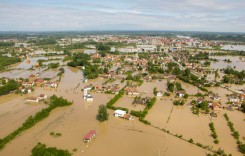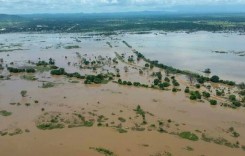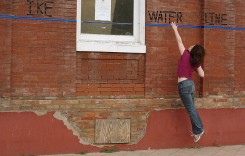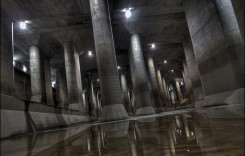
There is a meeting today (Thursday 13/06/13) between German Chancellor Angela Merkel and the heads of Germany’s 16 regional states. Obviously the recent floods in Germany will be high on the agenda.
But what lies ahead for the future of flood protection and prevention in Germany? This is the country that suffered so much in 2002. After those floods, plans were made, work carried out, flood defences raised…but just over 10 years later, huge areas of the country are yet again under water. So does this mean that planners got it wrong after 2002 and a new approach is needed? Or does it simply mean that not enough was done?
Some Success…but
There have been some success stories this time around. With the town of Grimma a notable exception, the state of Saxony fared better than in 2002, especially the capital, Dresden.
With the help of higher levees, flood walls and sand bags, emergency crews in Dresden managed to keep the water largely in the river this time. Overall, Saxony has spent around $1.7 billion on flood defence since 2002.
Jürgen Stamm, professor of hydraulic engineering at the Technical University in Dresden, says there have been plenty of measures taken in Saxony since the 2002 floods:
“In Saxony after 2002, authorities developed 47 flood protection concepts with more than 1,000 individual measures,” he says. “Levees were reinforced, some were moved back to give the river space for when the big wave comes. Bridges were remodelled to prevent the river from swelling underneath and reservoirs were built.”
Another flood protection success story in Saxony can be seen in the small town of Eilenberg, population 17,000. Eilenberg lies on the river Mulde and was badly hit in the 2002 floods. This time round, the town fared a lot better and remained relatively dry. Heiko Leihe of Eilenberg’s town government says:
“We built 6.5 kilometers of new dikes and the same length of new retaining walls. We also sacrificed part of an industrial park. We moved some of the walls and dikes further away from the riverbanks so the Mulde would have more room. As a result of that, the flooded river was not as fast as eleven years ago and therefore less powerful, less destructive.”
Giving the Mulde more room is part of an approach to flood protection often referred to as “Room for the River” which is at the forefront of flood prevention plans in the Netherlands. But it is often not without opposition from groups such as farmers, property developers or civic groups. Fortunately for Eilenberg, their plans didn’t come up against such problems.
So what went wrong?
Over the last few days we have witnessed the rapid building of makeshift flood defences across central Europe. Does this mean that despite past experience in 2002, some areas still weren’t prepared for flooding? Certainly cities such as Budapest (Hungary), Dresden (Germany) and Prague (Czech Republic) managed to keep the much of the flood water out – at least in central areas of the cities – despite record high river levels. This was in part down to newly installed flood defences, but there was also a need to build makeshift sandbag defences. But what about the towns and cities that did suffer – Grimma, Dessau, Magdebrug, Wittenberge, Passau…What went wrong?
Flood Prevention Measures not Enough
In many cases it was simply that the flood defences set up after 2002 were not enough. The floods were greater than 2002, which of course places more pressure on flood walls and dykes. Some flood walls were simply too low for a flood oft this magnitude. Passau was hit by the flood waters of three rivers. In other cases, such as Fishbeck in Saxony-Anhalt, dykes were reported as breached, unable to cope with the pressure of keeping out such high flood water.
Unfinished Flood Defences
In some cases flood prevention projects are unfinished and these floods came too soon. Wittenberge for example, was in the process of building or reinforcing flood defences. But work hadn’t been completed, which left the town needing help from volunteers to shore up weak (old) flood defences with tens of thousands of sandbags. Could it be that people have forgotten the chaos of 2002 and in some cases, flood defence work was simply put on a back burner?
Jürgen Stamm, professor of hydraulic engineering at the Technical University in Dresden, says
“It’s not the cost which is the main problem, but the willingness of people to live with the disadvantages of flood-prevention measures, which quickly diminishes after the flooding is over”.
Opposition to Flood Defence Plans
After 2002 in Germany, there were lots of plans and recommendations for flood protection projects, but not everywhere did these recommendations get implemented. It is natural to conclude this was down to lack of money. But that isn’t always the case. For example in Grimma, Saxony, which suffered some of the worst flooding in the state, there were plans drawn up for flood prevention measures that weren’t fully implemented due to opposition from a civic group.
The reasons for opposition may differ from region to region, town to town. But generally speaking, locals worry about large flood walls and dykes ruining their local landscapes. Farmers worry about losing available land, property developers and businesses likewise. One solution to ease river flooding is to introduce polders around the river areas. But this brings water closer to residential homes, raising the water table and often resulting in damp cellars.
Lack of co-ordination
It is the 16 separate state governments that are responsible for flood control in Germany. There is already some co-ordination between the 16, but currently there isn’t any kind of joint flood prevention. Joint action would hopefully avoid issues experienced by, for example, Magdeburg during the June 2013 floods.
Jürgen Stamm, professor of hydraulic engineering at the Technical University in Dresden says:
“the fact that Magdeburg has got so much water is due to the successful measures in Saxony.”
In other words, Magdeburg (Saxony-Anhalt) got Dresden’s (Saxony) flood, because Dresden built higher walls. Possibly a co-ordinated effort between states could have avoided this.
There are further examples of states taking different and separate approaches to flood prevention, for example the Elbe River which in parts divides Brandenburg and Saxony-Anhalt. Winfried Lücking, flood expert at Friends of the Earth Germany (BUND) says:
“East of the river, in Brandenburg state, the dykes are 80 centimeters higher than west of the river, in Saxony-Anhalt – you can imagine where the water goes.”
Lücking goes on:
“it’s high time the federal government took the lead in flood control to balance the errors of the states”
By errors he means that state governments have been focusing on unco-ordinated, short term solutions, such as erecting dykes, rather than longer term, wider solutions. A more joined up approach has to be the way ahead for Germany, if not on a federal level, then at least on a river basin level.
Over-Development
Over development is often cited as a contributing factor to flooding in nearly all countries, not just Germany. Simply put, land with buildings and concrete cannot absorb water as well as a green field or forest could.
Winfried Lücking, flood expert at Friends of the Earth Germany, says:
“Instead of confining rivers even further, levees should be moved back and space made for more flood plains: in cities and villages people must stop concreting over the ground and farmers must take up more natural cultivation. The land’s sponge-like qualities must be restored.”
This idea of restoring the land’s sponge like qualities leads us to a possible future solution for Germany’s flood protection: Room for the River. It’s not a new idea in Germany, just one that has struggled to take hold as much as it should. But with two devastating floods in 11 years, it may now start to gain more traction.
The Future: Room for the River?
Some time before the May and June floods in central Europe began, I wrote about a flood defence policy – more of a philosophy – in the Netherlands. The central part of this philosophy is to leave room for rivers, rather than wall them in. Space should be set aside for rivers to flood. If high water can be drained off in such designated areas, away from built up areas, then the chaos and suffering brought by floods in towns and cities will be avoided.
It sounds simple, even logical to the point where one might assume all flood defence planners take this approach. Of course a river needs space; it’s obvious. Well, it may be obvious, but it’s not so straightforward. If the river is given more room, then someone – farmers, residents, businesses – will have less room. It’s often a fight to make room for a river.
The official project website in the Netherlands says that the Room for the River project is “breaking the trend”. Because of endless development of towns and agriculture, the approach to flood defence has been to build more of higher dykes, simply to keep rivers where they are. However, in 30 different locations through the Netherlands, land will be designated as specific flood areas, so that if or when the river levels rise to flood levels, the water can be drained safely and efficiently into these areas. This is a longer term approach that understands that through climate change, flood levels are likely to rise to levels where even the highest and strongest dykes will be under threat.
Despite high levels in rivers recently, the Netherlands managed to remain free of flooding. And this is a country that is highly susceptible to floods, especially around the Rhine delta.
It does seem that the “Room for the River” idea is at least gaining some attention. In reaction to the recent floods, the German Environment minister Peter Altmaier said:
River terraces must be reclaimed as temporary overflow storage sites to prevent rivers peaking at dramatic levels….Dikes must be set back further from waterways, larger flood terraces must be designated, and, as a last recourse, expropriation of riverside homes and premises could not be excluded.
Germany has attempted to make some steps towards giving room for the river, but it seems objections from farmers or conservationists has held back plans.
Altmaier went on to say that, of 18 projects along the Elbe to set back dikes and create more floodwater space, only four had actually been realized, often because of objections by land owners.
Heinz Peter Wierig, one of the European partners in the flood prevention program ALFA, makes it very clear what Germany needs to do next:
“In Germany, we have been focusing on strengthening our dykes for the last twenty years. We cannot continue with this, because heightening dykes will enlarge the problems for the Netherlands. For our neighbours’ safety and for our own, we need to lower the water levels in our main rivers.”
Sources: DW; Haberler; Room for the River