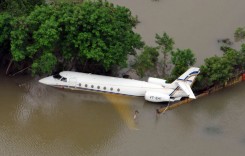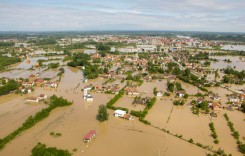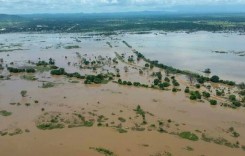
Strong winds, flash floods and torrential rain caused chaos for motorists and commuters in England yesterday, Wednesday 09 March, 2016.
Parts of central England were some of the worst affected by flooding. There were reports of cars submerged in flood water up to 1 metre deep in parts of Leicestershire and Warwickshire. Local media report that some motorists were stranded in their vehicles and required rescuing. Several schools were closed in Warwickshire.
Roads were blocked and rail transport severely disrupted, in particular between Rugby and Milton Keynes. A spokesman for train operator, London Midland, said: “Once the floodwater subsides we are still faced with trains and train crew out of place across the network.”
By the afternoon of 09 March, the Environment Agency had issued 43 flood warnings across England and Wales.
There are currently 55 flood warnings, meaning flooding is expected and immediate action is required, mostly for parts of the Midlands. There are also 164 flood alerts, stretching across England to the south coast and parts of the South West. There are no severe flood warnings, meaning danger to life.
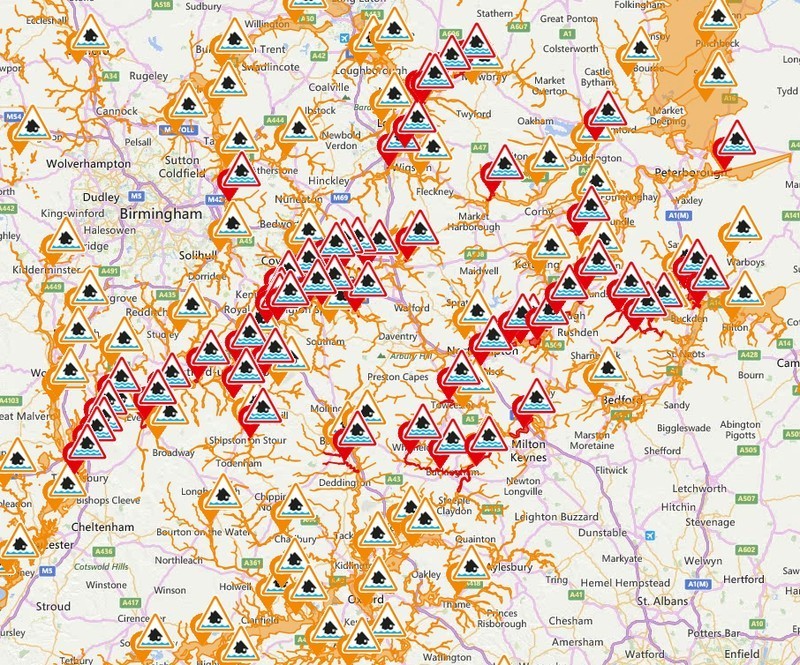
John Curtin, Interim Executive Director of Flood and Coastal Risk Management at the Environment Agency, said via Twitter that “the rain has cleared but we still have lots of water around,” and warned that rivers are still peaking.
Rainfall Figures
The Met Office said “Rainfall totals were in the order of 20-30mm with as much as 40mm possible once the rain clears later today. These figures are consistent with our forecasts and the severe weather warnings issued yesterday.”
Rainfall totals 10pm Tuesday 8 March to 10am Wednesday 9 March:
Stowe, Buckinghamshire – 36.0mm
Winchcombe, Sudeley Castle, Gloucestershire – 35.4mm
Pershore College, Hereford & Worcester – 34.6mm
Church Lawford, Warwickshire – 34.6mm
Larkhill, Wiltshire – 34.4mm
Westonbirt, Gloucestershire – 33.4mm
Northampton, Moulton Park, Northamptonshire – 31.2mm
Wellesbourne, Warwickshire – 30.8mm
The #stormwithnoname
The storm was described as the #stormwithnoname by some on social media, with many expecting it to be named as with previous storms (the latest being storm Imogen (07 to 08 February 2016) and Jake (01 to 02 March 2016).
The Met Office, together with Met Éireann started a pilot project “Name our Storms” during autumn last year to help raise awareness of severe weather.
The Met Office explained why this particular storm was left nameless. “Storms are named by the Met Office when medium or high impacts are forecast as a result of high winds. As this weather system was not expected to meet this criteria it was not named.”
Social Media
Same location as previous #flooding pic the flooded car shows how deep the water was in the other photo pic.twitter.com/76rmCxqQy8
— Ian (@iancharris) March 9, 2016
If driving through #Southam best to use the bypass @leamcourier @wcc_news @WarwickCops pic.twitter.com/vHJTg64c75
— SouthamFirst (@SouthamFirst) March 9, 2016
With high water levels across the area our staff are out and about working hard to keep communities safe #floodaware pic.twitter.com/kvBLxW3CY3
— Env Agency Midlands (@EnvAgencyMids) March 9, 2016
9 flood warnings & 47 alerts now in place across the area. Keep up to date at https://t.co/QzpM8KtjqB #floodaware pic.twitter.com/xnfkCpbFTd
— Env Agency Midlands (@EnvAgencyMids) March 9, 2016