Tropical Cyclone Tokage caused damage to homes and forced thousands to evacuate in the Philippines before moving into the South China Sea where it is expected to dissipate.
NASA’s Aqua satellite took a picture of the storm as it was being torn apart on 28 November, 2016.
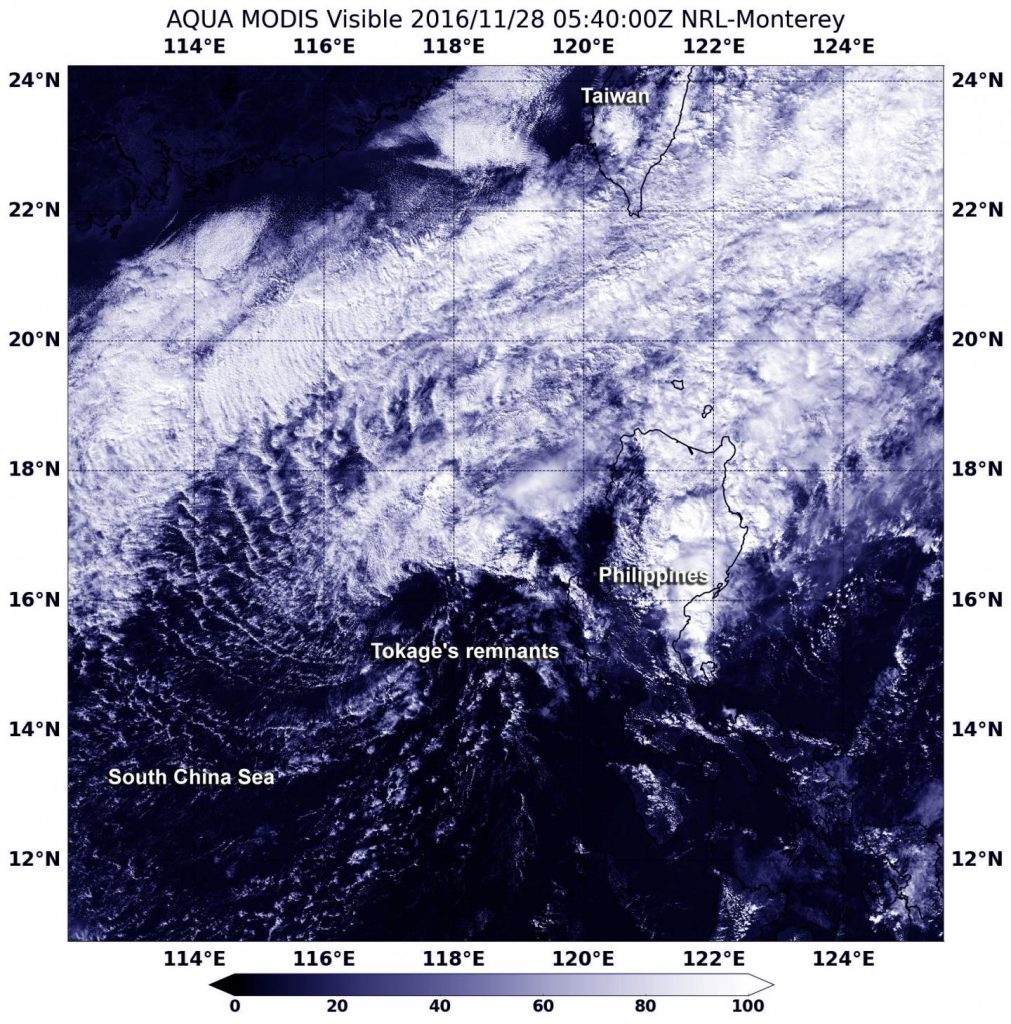
NASA’s Aqua satellite captured a visible image of Tokage’s remnants in the South China Sea on Nov. 28 at 1240 a.m. EST (540 UTC). Credit: NASA Goddard MODIS Rapid Response Team
According to NASA, the Moderate Resolution Imaging Spectroradiometer or MODIS instrument aboard NASA’s Aqua satellite captured a visible image of Tokage’s remnants in the South China Sea on 28 November at 12:40 a.m. EST (540 UTC). The image showed that the bulk of clouds associated with the remnants were pushed north of the center of circulation.
On 28 November at 4 a.m. EST (0900 UTC), the Joint Typhoon Warning Center (JTWC) issued their final warning on Tokage. At that time Tokage had maximum sustained winds near 28.7 mph (25 knots/46.3 kph) and they were weakening. The storm was located near 16.3 degrees north latitude and 116.7 degrees east longitude, about 242 nautical miles west-northwest of Manila, Philippines. It was moving to the southwest at 19.5 mph (17 knots/31.4 kph).
JTWC noted that “animated multispectral satellite imagery reveals that the remnants of Tokage has embedded within the northeasterly cold surge which has caused it to accelerate southwestward and almost completely unravel.”
The remnants are expected to continue to move to the southwest and completely dissipate.
According to European Civil Protection and Humanitarian Aid Operations (ECHO),
heavy rain affected several parts of the country causing floods and landslides.
Known locally as known as “Marce”, Tropical Cyclone Tokage brought heavy rain to some areas, with 133 mm in 24 hours in Iba (Zambales province, Central Luzon) between 27 to 28 November.
As of 28 November early morning (UTC), national authorities reported that over 14,300 people have been affected, over 12,400 evacuated and 16 homes damaged throughout the regions of Mimaropa, Eastern, Western and Central Visayas as well as Northern Mindanao.