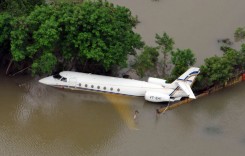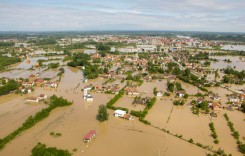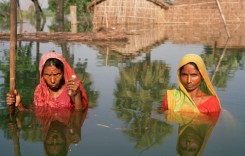
In February this year, the department of Beni in northeastern Bolivia was decimated by floods. Other areas of Bolivia were also affected but the flooding in Beni was by far the most severe and the most prolonged and the worst in living memory. Around 60 people were killed in the flooding, 63,000 hectares of crops destroyed, 110,000 livestock killed and livelihoods lost or ruined.
Mariel Cabero Ugalde is a project co-coordinator with Engineers in Action and a member of the volunteer group Support for Flood Affected Families in Beni recently visited Beni to see the aftermath of the flood disaster at first hand.

She met with flood victims, many of whom are still suffering months after the floods first struck. She was also able to take water samples and other scientific data, as well as meet with government authorities and community leaders. Mariel sent us her report below, describing the plight of the flood victims in Beni.
Some Areas Still Under Water
Although several months have passed, many of the roads are still impassable, leaving no choice but to travel in tiny, rickety airplanes.

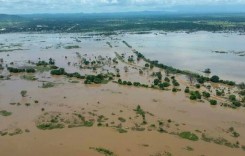
During the last week of June we made a trip to Santa Ana de Yacuma with a group of volunteers, we saw from the plane that large areas remain under water. Water levels have not yet fallen enough for people to return to their communities, and hundreds remain displaced. Even where water levels have receded, the destruction caused by the floods has been so severe, people have little to return home to.

Aid and Government Help
Santa Ana de Yacuma has become a center for refugees where families from many different communities are living in temporary accommodation. Aid for refugees from the central government was stopped on 01 July 2014.
Even before then, central government help for the flood victims in Beni was not what it should have been. There is also a problem with corruption and reports of people selling food and supplies sent by outside organizations to the flood victims.
The Municipal Government in Santa Ana de Yacuma is doing all it can. I met the mayor and he really wants to help the communities. He was frustrated because the central government did not help as they should. For example, there has been no central government help to build flood defenses.
Currently help for the flood victims is coming from Unidad de Gestión de Riesgo Municipal, FUNDEPCO, FAO, UNICEF, Visión Mundial (in Santa de Yacuma).

Many of the tents being used in the camps are from USAID. I assume these tents are old since USAID is no longer allowed to work in Bolivia.


Contaminated Drinking Water and Malnutrition
Most of these families consume water directly from the river, which, according to the analysis we did, is contaminated with coliforms. These results are supported by the reports of diarrhea in both children and adults. No analysis of the fish were made, but there is a chance that some of them are not good for consumption due to the contamination of the water.
I tested the drinking water in every community we visited. I tested water from the faucet (where available) as well as from the main source, usually the river or a tank. I found coliforms in every sample of drinking water apart from a tank in San Lorenzo (the only community with a tank). However, they still get sick and I assume this is because they use dirty containers.
For the testing, I used 3M Petrifilms, E.Coli and Coliform count plates. Thankfully there where no E.coli.

The contaminated drinking water means many people suffer from diarrhea. I also saw some evidence of malnutrition.
No Home, No Land
According to testimonies of those who have returned, it was devastating to find that everything had been wiped out from their communities. They did not to know where to start in order to rebuild their lives. Now they are afraid that when the rainy season begins in about four months, they will not have defenses nor elevated houses constructed.
When visiting different refugees in Santa Ana de Yacuma, we saw dozens of families who have lost everything and are still living in tents, with no possibility of earning a living or receiving aid of any kind.
When we asked what were their needs, the answer was unanimous; everything.
Working in an NGO that is focused on the poorest municipalities in Bolivia has led me to meet poor rural communities, but I had never before met face-to-face a family that has nothing, absolutely nothing, no home, no land.
Their hope and strength is amazing. “The people of Beni are proud,” said one of the community leaders. They stand with their heads up. The region desperately needs sustainable projects, technical training, schools, and a disaster prevention strategy. This is not the first time that Beni is under water, and it might not be the last.
Are we going to wait for the next rainy season, wait to see more flooded communities, dead cattle, and homeless families, before we talk more about the tragedy of Beni?

About the Author
Mariel Cabero Ugalde works for Engineers in Action, a charity with the aim of improving quality of life for Bolivian indigenous communities through partnerships between engineering organizations and communities. It has a particular focus on the provision of clean water. See more at their website here.
Mariel is also a member of the volunteer group “Support for Flood Affected Families in Beni“, who recently raised the money for the supplies distributed by Mariel and her colleagues during her recent visit to Beni. In the future the group plans to raise money to buy water filters to help improve the lives of those affected by the floods in Beni.
For further information on making a donation, please see the Better Place page here.
With many thanks to Mariel Cabero Ugalde, Support for Flood Affected Families in Beni and Engineers in Action. All photos are copyright Mariel Cabero Ugalde, published here with permission.