A new study by the World Food Programme has found that one people affected by floods struggle with price peaks on food for up to eight months after the shocks.
The study also found higher levels of acute malnutrition emerging in the wake of such climate-related events.
“There is strong statistical evidence that the price of staple foods in communities affected by climate-related shocks is higher than in non-affected communities; this lasts for up to eight months after a flood or a drought and up to six months in the case of a cyclone,” said WFP Representative Christa Räder.
The research, which sheds light on the impact of climate-related shocks and stresses on food security and nutrition in rural Bangladesh, was presented today by the World Food Programme (WFP), Helen Keller International, the Bangladesh Centre for Advanced Studies and the Institute of Development Studies, Sussex/UK. The study was conducted with funding from the International Fund for Agricultural Development (IFAD).
Fish Could be the Answer
The study goes on to highlight the critical role of fish as an essential source of protein and micronutrients, which becomes even more pronounced for food security and nutrition following a crisis. After floods and river erosions, fish tend to surface and are easily caught; they become crucial for the affected families’ diet.
One of the recommendations arising from the study suggests enhancing the protection of sources of fish. The study concludes that better integration of food security and nutrition into climate change focused programmes is essential, while programmes focusing on behaviour change could help defeat the social norm of women giving up meals to help their children, but at the expense of their own health.

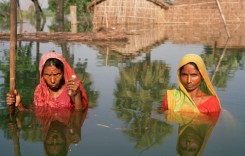
A home submerged by water-logging in Satkhira District. Photo: Kyle Knight/IRIN