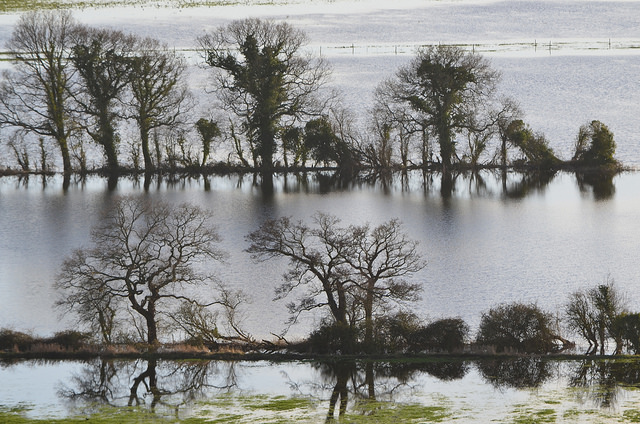
Floods which battered Southern parts of England in 2013 and 2014 are likely to have been caused by human-induced climate change.
Oxford University recently charged a team of scientist from across the globe to research climate change in the south of England, with particular emphasis on rainfall and flooding. Data was recorded and assessed from the winter of 2013/2014, when storms in the south were particularly bad. Analysis showed that the damage in the area was directly caused by climate change, which was itself induced and influenced by humans.
The floods of 2013/2014 devastated the south of England, and were caused by a barrage of storms that battered the coastlines and inland. A number of people lost their lives during the more violent parts of the storms and flooding, and damages claimed reached a cost of £451 million in insurance.
Januarys as wet as this one in particular used to be a rare thing, often only occurring once every one hundred years. However, data showed that the risk had increased by 43%, and was a direct cause of greenhouse gas emissions. The rainfall during this time was unexpected and extreme, and caused by two specific issues: westerly air flow and the atmosphere in the area holding more water.
The results published in Nature Climate Change showed that one third of the heightened risk was due to dynamic changes, and two thirds were down to thermodynamic changes. The study took every possible factor into account, from start to finish of the storm, including rainfall, atmospheric pressures and circulation, flow of rivers and the risk factors of the areas (the worst hit being the Thames Valley, Cornwall, Devon, Dorset and Somerset).
Dr Natalie Schaller, the lead author of the study, stated “We found that extreme rainfall, as seen in January 2014, is more likely to occur in a changing climate. This is because not only does the higher water-holding capacity lead to increased rainfall, but climate change makes the atmosphere more favourable to low-pressure systems bringing rain from the Atlantic across southern England.”
As well as data from this period, researchers also employed simulations to assess possible outcomes of different levels of rainfall in the United Kingdom, and hydrological modelling of the Thames River.
One of the senior researchers of the study, Dr Friederike Otto, said: For the first time ever, this study doesn’t stop at rainfall and river flow but attributes the change in risk from the meteorology down to the direct impact of flooded houses in the river catchment zones.’
Data confirmed that human-induced changes were the cause of higher peak river flow, which increased by 21%, and that flooding was possible in one thousand properties. Co-author Professor Rob Lamb said: ‘Each of these steps reflects different sources of uncertainty, but we find overall that there is a substantial chance of more properties having been placed at flood risk because of past greenhouse gas emissions, leading to potential damages that could be part of the losses incurred in 2013/14.’
The paper ‘Human influence on climate in the 2014 southern England winter floods and their impacts’ is published in Nature Climate Change.